Showing posts with label photographs. Show all posts

Thursday, June 16, 2016

What do you do with old photos?

Binders circa 1930
My mother asked, “What will you do with all my photographs when I’m gone?”

Being her smart aleck kid, I said, “They’re going with you.”

The joke’s on me, though. After sorting through a small fraction of inventory during her move from house to apartment, I developed a sentimental attachment to quite a few.

The problem is she has several large plastic bins filled with family photos. I don’t know how she collected so many, because I don't recall ever seeing her with camera in hand. My brother thinks digitizing them is the answer. I don’t know if it’s worth the trouble and, even if it was, would we really be able to throw away the old prints?

This is more than a philosophical question for me. I printed my first black & white photos in a small science-class darkroom in junior high. In high school, I converted a closet into a part-time darkroom and continued printing there. For a few years, I worked for a pharmaceutical giant as a photographic specialist. There I furthered my skills printing photographs used, in those pre-PowerPoint days, in business presentations and also for product publicity and scientific test results. One perk of the job was the freedom to print my own work as well.
A recent and rare sighting: 35 mm film on store shelves.

Now I have a walk-in closet packed with slides, contact sheets, negative sleeves, and prints, prints, and more prints. Compounding the problem (or the riches) is the fact my husband is an avid photographer, and so we also have boxes of prints cataloguing his early years of documenting events for family and friends. If it weren’t for digital photography, we would have had to build an addition years ago to hold our growing collection of images.

Lately, I’ve taken to giving old photos to the people who are in them. I don’t know if I’m doing them any favors, as most focus on how young they used to look 20, 25, even 30 years ago. Seems no one likes to be reminded about time marching on.

And so my closet shelves will continue to groan under the weight of boxes of memories of years past, barely lightened by the few photos I manage to give away. If I can avoid adding to the stockpile, and not inherit my mother’s stash of photographs, I will consider myself a very, very lucky girl.

Monday, May 4, 2015

When negatives prove valuable

This story begins with a picture taken decades ago and ends this week, following a funeral, a mystery, and a mix of technologies. 

I was attending the funeral for a beloved aunt. While paying respects to the family, I glimpsed a photograph that looked familiar. It was taken in my parent’s home. By me. More than 30 years ago.

In the photo, my aunt and uncle were sitting together, looking happy and peaceful. But who was the woman at the end of the couch? This was one of the few photos of my aunt and uncle together at that time -- he died not too long after -- I was determined to find out what I could about the third party.

To unravel the mystery of an early 1980s color print, I snapped a picture of the framed photo with my smartphone and emailed it to several family members. A cousin confirmed it was taken at her bridal shower, and the unknown woman was from her father’s family.

I shared this information with the grieving family, glad to put a date, occasion, and name to the photo. Still, I wasn’t satisfied. I had taken the shot, so surely I must have more photos somewhere from that day.

I visited my photo archive, also known as the top shelf of a rarely used bedroom closet. I combed through boxes of photos, but couldn’t find anything. I flipped through pages of slides; still, no success.

Finally, I dragged down an overstuffed binder of negative sleeves and contact prints. Depending how young you are, that previous sentence probably made no sense. Let’s just say I went through my old photography paraphernalia and found exactly what I was looking for.

So now what? I really wanted my cousins to have a nice picture of their parents, just the two of them, without the unrelated woman crowding in. I pulled the negative and handed it to my husband, who's more tech savvy. I thought he could erase the third person from the couch through some software wizardry, but I’ve been watching too much CSI on TV.

He took an old-fashioned approach using much newer technology. Basically, he scanned the negative into PhotoShop, adjusted color and contrast, cropped in close on my aunt and uncle, and then saved it as a .JPG. I emailed the new version to family members and, if they wanted, they could get an actual print to replace the old framed one by sending it to anyone from Walgreens to Shutterfly to Mpix. 

Only later did I reflect on the technologies involved in bringing new life to an old photo, taken with a 35mm SLR camera. Again, depending on your age, you may not know the camera reference, but you could always look it up on your smartphone.

I had been tempted once or twice to throw away all my old negatives. I couldn’t imagine ever printing them again. Now I know they’re a valuable resource and a tether to my past. As for printing, well that has taken on new meaning when you can email images and have prints ready for pickup or arrive in the mail.

Once again I find new technology never really replaces old technology. Drawing on the strengths of each, you get the best of both worlds. In this case, a positive negative.

Wednesday, December 10, 2014

Cloud cover isn’t picture perfect

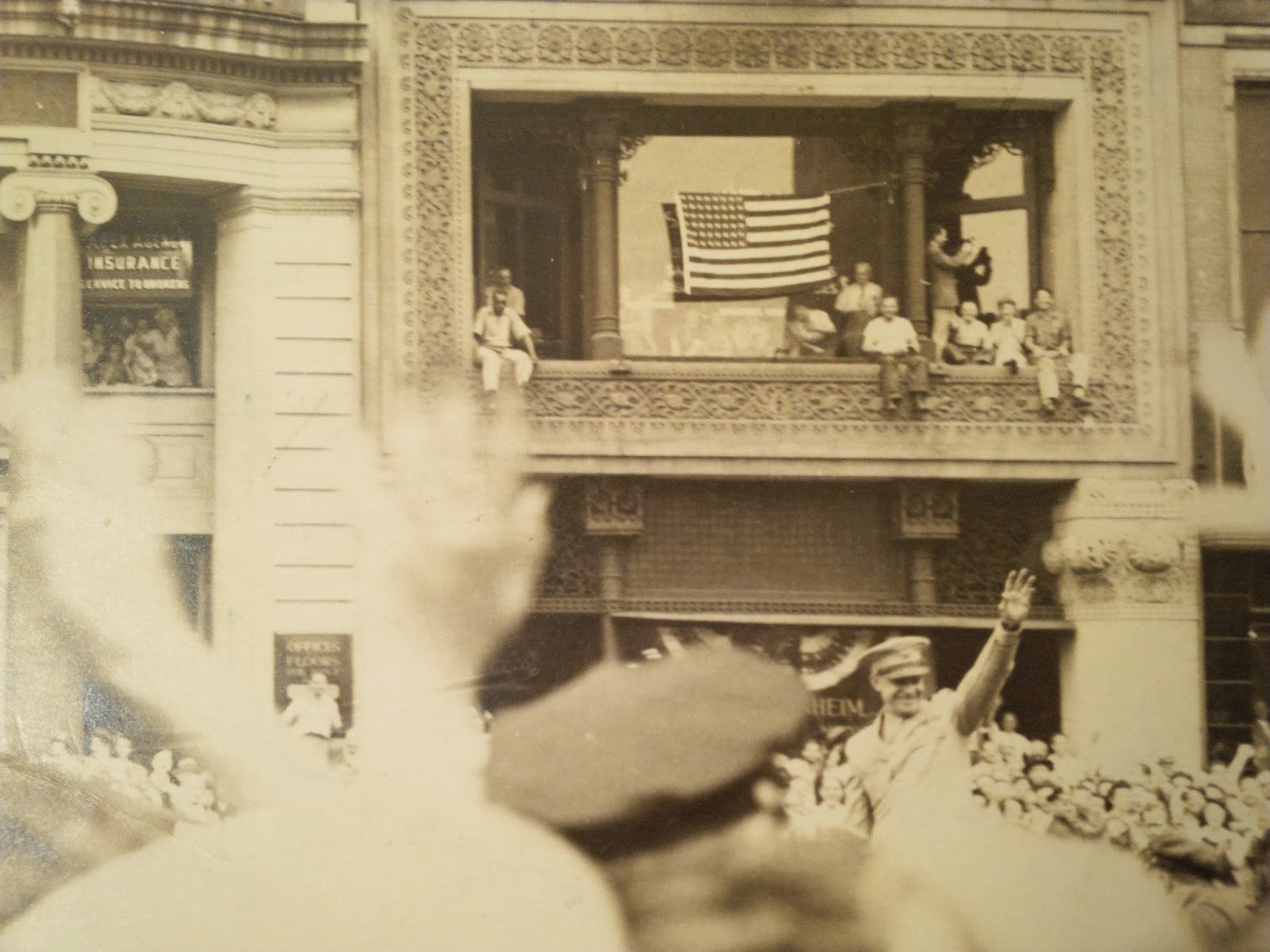
There’s my granddad. Up on the ledge. Legs hanging over. Nearest the American flag. Watching Gen. Dwight D. Eisenhower in what remains the largest parade in New York City’s history, in June 1945. Celebrating Germany’s surrender in World War II.

I found this picture while combing through old photo albums with my mother. On the back, my grandmother had written a sweet note to her son, my father, who was then serving in the Navy.

My friend is on a similar search for family history. He recently emailed about an upcoming trip to visit an aunt in Florida. “I'm taking a sharpie so she can identify people in her photo albums.”

With photo albums on my mind, I started sorting through my own stash. I removed photos from the “magnetic” albums, where a clear plastic overlay sticks to the page…and, as I found out, also discolors and damages the photos. But I have thousands of photos – from wallet size to 11 x 14 prints – stored in drawers and boxes and photo sleeves. They span my early explorations with cameras right up until I grew bored with snapping the same family celebrations, year after year after year.

Then digital cameras and, even better, smartphones became the tool to use. Where are these pictures stored? In my computer. On CDs. Saved on USB drives. A few uploaded to the cloud.

As I replied to my friend with the sharpie: It’s hard to think digital photos will ever have as much impact as stumbling across the Eisenhower photo. It's too easy to tuck them away in digital storage. “Will next generations take the time to search?”

His short answer: “No.” I think he’s right. While digital photos are certainly searchable, you often don’t know what you’re looking for – or at. And out of sight is certainly out of mind.

Nothing beats sitting shoulder to shoulder on a couch, flipping through pages to reveal long-gone relatives, while teasing out stories of days past. Huddling around a computer (or notepad or other electronic device) just isn’t the same. There are no charming handwritten notes on the back. And one bad swipe, missed click, or timeout and my tech-adverse mother loses interest. 

She still has my late father's computer, on which there are lots of family photos, but she never turns it on. If we want her to see the latest photos, we email them to the local Walgreens, which prints them out and calls her to pick them up.

She only keeps the computer around so my siblings and I can print out boarding passes when we visit. And for that small favor, I am grateful.

Sunday, July 1, 2012

Picture this


Maybe it’s me. When I think of “social” media, I expect to interact with someone on more of a personal level than, say, a business communication. The difference can be as minor as seeing a picture – of having a face to connect to a name.

True, the headshots can be so small as to barely indicate human versus plant existence – especially on a smartphone – but they’re a start.

What amazes me is how so many people make such bad choices when it comes to their photos. “Bad” as in:

  • Cutting what is obviously a couples photo in half. (We can still see your partner’s arm around your shoulder.)
  • Holding your smartphone at arm’s length and clicking away. (Now we can see your arm, and it looks freakishly out of proportion to your head, thanks to the wide-angle lens.).
  • Repurposing a candid from a wedding or other formal event. (Woo-hoo! You look like you’re having a great time, but your glassy stare says you're having too much fun to drive. You might want to use a different picture for LinkedIn, especially if you’re job-hunting or looking for clients.)
Good pictures are hard to capture, even with the abundance of cameras available on phones and tablets, not to mention digital cameras of all sizes and price ranges. And sitting for a picture can be a painful process. (Is that really what I look like?)

I share your pain. I just went through an agonizing photo session to update my social media photo. At least clients will recognize me when I walk in their door.

It can be tempting to opt out of posting a picture, to prefer the mystery of staying hidden. But it’s hard to take someone seriously on social media when staring at their default no-photo stand-in or Twitter egghead.

Tuesday, November 1, 2011

It's all about ME

Imagine a camera designed to put you at the center of every picture, every time. That may not have been the original idea behind the Throwable Ball Camera, but that's what it does. Along with capturing an amazing panorama overhead.


The ball also has captured the attention of sports fans, who see its potential for revolutionizing sports coverage. (See ThePostGame.)

Who wouldn’t want this camera/toy/device/equipment? It takes the current ME culture one step further to put ME at the center of my universe in a concrete and visual way.

Every single picture I take would feature ME with my arms outstretched, ready to embrace the world. Or rule it.

Monday, March 22, 2010

Beauty, truth in Haiti

Many have documented the devastation and disaster-relief efforts in Haiti following the January earthquake and its aftershocks. Most of the photos have filled me with sadness and compassion. Today, I saw the work of one photographer who managed to convey the beauty and strength of those who were affected -- and those who went to help.

Ed Wheeler has always been an amazing talent. For years, he was my go-to photographer for corporate annual report shoots, from the boardroom photo to round-the-world and through-the-manufacturing-plant pics.

Now he has turned his camera to the bareness of survival and the abundance of caring. He shares his work in the following presentations:
The images are as beautiful as the situation is unfathomable. 

Thursday, September 24, 2009

Colorful characters?

I've heard that three occurrences make a trend, so here's the latest trend I've observed. A number of colorful, creative types who have started or manage top-notch design firms are losing their vibrancy. Well, not them -- it's their photos. A quick glance at my "Network Updates" homepage on LinkedIn shows more than a few are now using black & white portraits.

I know B&W can be more dramatic, with rich tones across the gray scale, but consider the medium: The Internet, with a photo smaller than a postage stamp. Just how much detail is possible?

Actually, I'm a fan of B&W photos, having grown up souping negatives from film cameras and watching images emerge in darkroom developer trays. An Ansel Adams exhibition can still bring me to tears. The use of B&W to stand out from the clutter of color can be quite effective -- until everyone starts doing it.

Maybe a postage stamp isn't such a bad model for the kind of photo to use on a social networking site. Consider the Simpsons postage stamps unveiled in May. Simple. Colorful. Memorable. Almost makes you want to pay bills the old-fashioned way: by mail.